I happened to be visiting Ramapo College in New Jersey the other evening and, in a hallway outside a counseling office, passed this display of literature aimed at reducing college drinking. Didn't have a chance to meet the counselor or ask questions, but it looked like a big step forward from my college days (eons ago). The bulletin board display points out that a large majority of students think that college students are heavy drinkers, whereas in fact, most students drink lightly. The false expectation likely promotes heavy drinking behavior and the accurate survey tends to put on the brakes. The display also includes handouts on alcohol and related issues. If material of this kind, backed by a proactive counseling staff and supported by the administration, had been available in my day, I might (might) have been spared three decades of alcoholic drinking. The world needs new models of recovery from addiction to alcohol and other drugs. This blog is my classroom, where I learn about the many issues involved in addiction and recovery. You're welcome to look over my shoulder as I learn, and to enter your comments.
Sunday, August 29, 2010
Some Progress on Campus
I happened to be visiting Ramapo College in New Jersey the other evening and, in a hallway outside a counseling office, passed this display of literature aimed at reducing college drinking. Didn't have a chance to meet the counselor or ask questions, but it looked like a big step forward from my college days (eons ago). The bulletin board display points out that a large majority of students think that college students are heavy drinkers, whereas in fact, most students drink lightly. The false expectation likely promotes heavy drinking behavior and the accurate survey tends to put on the brakes. The display also includes handouts on alcohol and related issues. If material of this kind, backed by a proactive counseling staff and supported by the administration, had been available in my day, I might (might) have been spared three decades of alcoholic drinking. Wednesday, January 21, 2009
Congratulations to Barack Obama

As a college student at Wesleyan in '61 (or was it '62?) I joined with other white students to team with groups of black students from Howard University in an effort to integrate lunch counters in Glen Burnie, a suburb of Baltimore. In some places we sat indefinitely without being served; in one, we were served coffee with salt in it; at another they locked the doors as we approached. When we picketed the segregated local movie theatre, a mob of white men surrounded us as sheriffs watched. A providential cloudburst scattered the crowd and allowed us to escape.
Sunday, December 16, 2007
College profs modeling alcoholism for students?
"Can we acknowledge that there is a huge amount of alcoholism in academia? Not the cute Dudley Moore kind, but the kind that makes us less sharp and ends our lives early? I'd imagine every one of us knows a colleague who needs a mid-morning 'refresher' or who always smells slightly of drink. I remember seeing my supervisor trying to be inconspicuous checking all the (empty) wine bottles at a reception, hoping there was a glass left in one of them, and finally making a glass by combining all the remnants red and white wine that were left. I remember drinking with him at a local bar until well past midnight (having started at four). And is there any function in academia that doesn't involve alcohol?"Read the whole thing. Good point. A college administration trying to cope with its students' alcohol excesses needs also to look in the mirror. It'll be hard to get a handle on student conduct if the faculty's drinking is out of control.
Sunday, February 25, 2007
Annapolis: New rules decimate drinking
Following a series of sexual crimes linked with alcohol last fall, the Academy adopted new rules that prohibit all underage drinking. Students over 21 are limited to one drink per hour and three drinks on any given evening, not to exceed 0.08 blood-alcohol content, the legal standard for drunken driving in Maryland and many other states.
Those who fail random breath tests are counseled the first time, but those caught twice, or with higher than a 0.15 blood-alcohol content, can be disciplined with restriction to the dorm, 5 a.m. marches and even expulsion. Academy authorities said that enforcement has been strict and effective.
In a recent memo, the student drug and alcohol coordinator warned of infractions and urged students to take the policy to heart. Source.
Friday, February 23, 2007
Mom sues frat, college over boy's alcohol death
Boulder, CO: The mother of Gordy Bailey (photo), a Colorado University freshman who died of alcohol poisoning at a fraternity initiation in 2004, is suing the fraternity and the university for negligence and reckless misconduct.A superior court judge has ruled that the lawsuit can go ahead and has set a March 2008 trial date. Source.
A coroner revealed that after Bailey had passed out, his fraternity brothers marked up his arms, legs and trunk with racial and sexual slurs, said the young man's father, Lynn Gordon Bailey.
"This reinforces the nearly unbearable pain of the whole thing," Bailey said. "Was he dying while they were writing that?"
When it became apparent that the 18-year-old was not breathing, and police were going to be called in to investigate, someone tried to wipe off the slurs that were written on his face with a felt-tip marker, police said. Source.
Bailey's death has similarities to the fate of Phanta "Jack" Phoumarrath at the University of Texas, Austin. Link.
Saturday, February 10, 2007
Star USC kicker falls off cliff drunk
Los Angeles: University of Southern California star field goal kicker Mario Danelo was drunk when he plunged over a cliff to his death, the coroner's office said Jan. 9. His blood-alcohol level was 0.23, nearly three times the legal limit in California.Danelo, 21, was found Jan. 6 more than 100 feet down a rocky cliff in San Pedro.
Danelo made 15 of 16 field goals this season and led the Trojans in scoring with 89 points. He made two field goals in the Rose Bowl on New Year's Day to help USC beat Michigan 32-18. Source.
Wednesday, February 07, 2007
Colorado lecturer dies drunk in snow
A University of Northern Colorado sociology lecturer who was found dead in a snow bank at the Foothills Unitarian Church in Fort Collins died of hypothermia due to acute alcohol intoxication, the Larimer County Coroner’s Office ruled today.She was reported missing on Jan. 2 by her husband after having last been seen New Year’s Eve.
Four children playing at the church before services almost a month later saw her body partially covered by snow. They called a parent, who notified police.
Family members said Wilkins-Wells was believed to have been headed to church the day she went missing. The family belongs to Foothills Unitarian, which is about two miles from their home.
Wilkins-Wells had been a sociology lecturer at UNC since August 1992, specializing in minority relations and community planning.
Katie Wilkins-Wells said that her mother had started having problems with alcoholism two years ago and had joined Alcoholics Anonymous. Source.
Saturday, January 27, 2007
Student dies of alcohol OD, college clams up
Contacted with the medical results, York College spokesman David Salter said "No comment."
Source.
Saturday, January 13, 2007
Campaign knocks drinking games off shelves
Three of the nation's larger retailers -- Kohl's, Target, and Linen's & Things -- have removed board games that encouraged binge drinking, following a coordinated public opinion campaign aimed at curbing underage alcohol consumption.The games, with names such as Shots 'n Ladders, Drinko, and Keg Pong, are takeoffs on popular children's board games, but players take drinks instead of accumulating points. Details.
Spearheading the public opinion campaign were local groups such as the Oregon Partnership with coordination by national groups like Join Together, the Center for Science in the Public Interest (CSPI), and Community Anti-Drug Coalitions of America (CADCA).
More on the campaign.
Thursday, January 11, 2007
Frat brothers defaced dead boy with magic markers
His lifeless body was defaced with offensive remarks from head to toe. That's what an autopsy released Tuesday Jan. 9 2007 shows happened to Phanta "Jack" Phoumarrath, the University of Texas (Austin) fraternity member who died of alcohol poisoning in 2005.
It also shows his blood alcohol content was five times the legal limit.
Some members of Lambda Phi Epsilon have been indicted in his death.
The family's attorney says the suspects seem to have spent a considerable amount of time drawing on Jack, when they could have been helping him instead.
"They wrote a variety of things, most of which would be considered juvenile. Some of which were lewd. It was disappointing and certainly discouraging to the family that people who hold themselves out as fraternity brothers would do something like this," Phoummarath family attorney Randy Sorrels said.
UT suspended Lambda Phi Epsilon as a registered student organization until 2011, after determining that hazing had occurred. Source.
Many of the epithets scrawled on Jack's body were homophobic. Source.
Monday, January 01, 2007
Drunk freshman kills campus cop
Responding to the death, University authorities deplored a "culture of alcohol" and called for a study group to come up with recommendations. The local Baptist church called for prayers and condemned a climate of "moral indecency." Translation: after the handwringing, nothing will change.
Thursday, December 21, 2006
Frat culture takes another life
Dallas: Jacob Stiles, 20, who was found dead inside his Sigma Alpha Epsilon fraternity house at Southern Methodist University earlier this month, died of a lethal combination of alcohol and drugs, medical examiners said today, following an autopsy. Source.Stiles had been a lifeguard and swim team member at White Eagle Country Club in Naperville and varsity swimmer at Neuqua Valley High School, his alma mater. Source. At SMU, Stiles won the title of Mr. University (photo) in a fund-raising pageant held by the Pi Beta Phi sorority earlier this year. Source.
Monday, December 18, 2006
Students defeat trademark for "Cocaine" drink
According to Irina Vinogradsky and Angela Simmons, they and the three other students were partly motivated by personal feelings against the name “Cocaine.” “It’s not just academic to everyone in the group,” said Ms. Vinogradsky, adding that the students shared a “very strong feeling that it’s immoral.”Read details in the New York Times. The students also claimed that the label was deceptive. The maker claims that the drink contains 280 mg of caffeine plus a confidential ingredient that supposedly provides a lasting "energy buzz." Source.
The drink's inventor, James Kirby, 42, says, “We had little money for marketing and advertising, so we chose a way to get as much as we could for free." The strategy worked; the notoriety and controversy surrounding the name got priceless headlines, including the New York Times story.
The Food and Drug Administration hasn't been heard from yet. You can't legally label iced tea "Whiskey." And the Coca-Cola Company hasn't weighed in yet, either; Kirby's new bright red beverage containers bear a remarkable resemblance to Coke, whose original formula actually contained what Kirby's drink only pretends to.
For one trademark lawyer's commentary, see this blog.
Sunday, December 03, 2006
College alcohol culture claims another victim

Exeter, UK: Gavin Britton, an 18-year old Exeter University student whose MySpace website featured photos of himself chugging alcohol (right) has died from alcohol poisoning. Source.
Wednesday, November 15, 2006
Rape victim rejects 9th step "amends"
Liz Seccuro (photo), 39, together with her husband and a number of sorority sisters, stood in a Charlottesville court room yesterday and avoided the eyes of her assailant, William Beebe. Outside court, Seccuro said tearfully, "I think that the idea of closure for any victim of a sexual assault is not reality. There is never closure."Beebe sent Seccuro a letter last year confessing to the rape as part of his AA ninth step work, which requires "making amends" to persons harmed. After several email exchanges, Seccuro turned the correspondence over to prosecutors, who had Beebe extradited from his home in Nevada and brought to stand trial in Virginia. Beebe may not have known at the time he sent his letter that there is no statute of limitations for felonies in Virginia.
In court, Beebe pleaded guilty to a reduced charge of aggravated sexual battery, and will face a possible two years in prison. He was originally charged with rape and sexual penetration with an object, charges that carried the possibility of life in prison.
Seccuro spoke out about her experience and founded an organization called STARS -- Sisters Together Assisting Rape Survivors -- to raise money for programs helping rape victims and their families. Read Liz Seccuro's story in her own words here.
Epilogue, Jan. 25 2007: More details of the crime, Seccuro's feelings following court hearings: Rapist's quest for forgiveness revives victim's worst nightmare, here.
Federal judge turns against crack penalties
US District Judge Reggie B. Walton told the US Sentencing Commission that federal laws requiring dramatically longer sentences for crack cocaine than for cocaine powder led to the perception within minority communities that courts are unfair.
Walton said a white college student arrested with a kilogram of powder cocaine would probably get 3 to 4 years in prison, while a black high school dropout caught with the same amount of crack would face a mandatory 10-year sentence and the possibility of a life sentence. Read more.Between 1989 and 1991, Judge Walton served as President George H. W. Bush's Associate Director of the Office of National Drug Control Policy in the Executive Office of the President and as President Bush's Senior White House Advisor for Crime.
Monday, November 13, 2006
Family voices outrage over drunk car killer
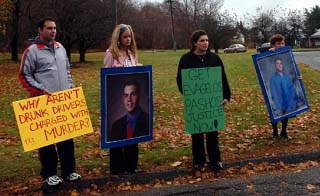
BOSTON: "Why aren't drunk drivers charged with murder?" read a sign carried by family members of slain Suffolk University student Evagelos Pashos, 21, of Shrewsbury, near Boston. The family and friends expressed their grief and outrage at the court hearing for the accused driver, who collided head on with Pashos' car, fatally injuring the student. The accused, 47-year old Alison Voorhis, was charged with vehicular manslaughter. Source. The family's noisy demonstration at the court hearing -- they packed the courtroom and vented their grief and anger at the defendant -- speaks to growing frustration with the relatively lenient treatment given to people who kill people with cars while under the influence, compared to other types of homicide.
Frat life: Beer, urine, vomit
Following this Oct. 26 incident at University of Central Florida, the national board of the fraternity disbanded the chapter. "Our board does not feel it's worth the effort to rehabilitate the group," a spokesman said. Source.
About time. When will the rest of the Greek world take a hard look at itself and reach the same conclusion?
Wednesday, November 01, 2006
Students Against Drunk Driving
Amy Gnotek, MSU senior, knows all too well the damage drunk drivers cause. She's lost two high school friends, an aunt and uncle in separate drunk driving accidents. That's why she's organized Spartans Against Drunk Driving: "It's just hard, and I know it's touched a lot of lives a lot of families." Source.
Amy says the 40,000 students at her school are known for partying. East Lansing Police Chief Tom Wibert agrees. The department has reached a 15-year high on the number of drunk driving arrests, and now he's helping these students work on prevention.
Go, Amy!
Sunday, October 08, 2006
Fraternities: Another Jungle
Oates' fictional story describes the death of Hector Campos Jr., a Latino student at Michigan State University, who got drunk and either fell or was pushed down a trash chute into the dumpster behind the Phi Epsilon fraternity. Authorities found his body three weeks later -- three weeks of agony for his parents -- in the county landfill. Oates writes in a documentary style, sequencing factual detail after detail until the resulting tapestry becomes emotionally overwhelming.
Newspaper reports of real deaths of real college students don't seem to have made much of a dent in the college fraternity drinking scene. Source. Maybe Oates' intensely felt and written fictional piece in the New Yorker will succeed where journalism has failed. Thank you, Ms. Oates, for the effort.