Showing posts with label India. Show all posts

Saturday, October 30, 2010

If Alcohol Were Invented Today

[Originally posted on hellowellness.in 29 Sept 2010]


The word 'alcohol' was coined around 1540 by an Arabic chemist to describe the fine powder, or 'kohl,' used to stain or paint the eyelids.  Two centuries later, British writers borrowed the word to describe the intoxicating essence of wine -- an ironic twist, since the original Arabic chemist was very likely a Muslim and, as such, forbidden to drink it.  

If alcohol were invented today, international law would class it with the controlled substances, alongside opium, heroin, cocaine and the like.  The World Health Organization (WHO), in its most recent comprehensive report, writes:
Alcohol is a psychoactive substance with a known liability to produce dependence in humans and animals. If considered in the frame of the 1971 Convention on Psychotropic Substances, alcohol would qualify for scheduling as a substance that “has the capacity to produce a state of dependence, and central nervous system stimulation or depression, resulting in hallucinations or disturbances in motor function or thinking or behaviour or perception or mood”, and for which “there is suffi cient evidence that the substance is being … abused so as to constitute a public health and social problem warranting the placing of the substance under international control.”

The propensity to produce "dependence" -- a bland synonym, in this context, for the more controversial term "addiction" -- is the red flag that sets apart this relatively small class of drugs, including alcohol, from the millions of other known chemical compounds.  They are addictogenic.

The exact molecular mechanism of addictogenesis is still the focus of scientific investigation in several countries.  But the fact of its occurrence is beyond dispute.  The WHO report says, "The direct actions of alcohol on the brain and sustained alcohol exposure lead to longer–term molecular changes in the brain known as neuroadaptation."  That is, a number of neural pathways in the brain are altered to form a strongly self-reinforcing habitual behavior pattern that leads to adverse consequences for the organism.  

Among the pathways by which alcohol enters the brain is the brain's indigenous opioid system -- the same doorway by which the opiates such as heroin and codeine pass into the neural network.  

Wherever alcohol is introduced into a country on a large scale, there one finds the rise of alcohol addiction (alcoholism).  The WHO world surveys find a strong correlation between the level of alcohol consumption in a country, and its prevalence of alcohol dependence.  Statistically, more than three quarters of the dependence rate is correlated with the level of consumption, and this trend is even stronger in "developing" countries, among which the WHO report specifically names India.  

Alcohol marketing generates alcohol use.  Alcohol use generates alcohol addiction.  Alcohol addiction then sustains the alcohol market. 

In any country where alcohol use has become established, writes the WHO, a small minority of drinkers consume the bulk of the alcohol sold.  "A typical finding is that half of the alcohol consumed is consumed by 10% of the drinkers."  In the U.S., some reports indicate that 10 per cent of the drinkers drink 80 per cent of the alcohol.

Imagine, then, that by some magic pill you could  convert the 10 per cent into non-drinkers.  The alcoholic beverage market would crash more profoundly and disastrously than the mortgage and financial markets in our recent meltdown.  

The alcoholic beverage industry worldwide is absolutely built on alcohol addiction.  One has to say it; there is no way to sugarcoat it.  

Recently, after I outlined these economic facts to a person newly in recovery from alcoholism, she exclaimed, "But that's so illogical!"  

Of course, it's utterly illogical.  We have grandfathered alcohol and tobacco into the category of legal substances, even though the combined death toll from these two drugs is perhaps 15 times greater than the toll from all of the drugs proscribed as illegal.  

So, we have prisons full of people caught using or selling negligible quantities of drugs whose total impact on society is relatively small, while the pushers of mega-quantities of lethal addictive substances that kill as many people each year as die in major wars, floods and earthquakes sit in luxurious offices with princes, prime ministers, and police chiefs on their speed dials.  

Meditation can provide lucidity at times of mental turmoil.  My friend who exclaimed at the illogicality of current addiction policy became agitated and, for a while, I feared that the mental stress would tilt her toward relapse.  I suggested meditation, and she calmed down.  The next day we met and I asked for her thoughts.  

She said that after thinking it through, she was more determined to remain free of addictive substances than ever.  Said she, "I don't like being used."

Monday, January 29, 2007

India: Alcoholism fuels religious riots

People from the upper castes used alcohol and money to incite Hindus to launch riots against Muslims in Gujarat state, India, say members of a local community peace association.

The committee of 30 neighborhood volunteers, including both Hindus and Muslims, has set itself the mission of trying to stop more riots before they occur. Since a giant pogrom against Muslims in 2002 (photo), in which more than 1,000 lost their lives and hundreds of houses were looted, community tensions have been high.

The association's members say that most communal violence is “created” and is seldom the “spontaneous outburst” that it is touted to be. In their ward, fights usually start when drunkards come to buy the food sold at the laris (pushcarts), many of which are owned by Muslims.

“It will start with abuses, then they will fight, someone will get beaten up, and one group will organise a mob,” says Solanki, one of the members. Adds Shaikh, another member: “It is under the influence of liquor that people throw stones and fight — in our area, alcoholism is the biggest problem.”

Though prohibition is in force in Gujarat, illicit brewing and sale of liquor is widespread in the state. As one of its first initiatives, the association hopes to enlist the community’s help in stopping bootlegging in the locality. Details.

Tuesday, December 26, 2006

DEA covering up Afghan heroin tide


The Bush administration's Drug Enforcement Administration (DEA) is trying to cover up the surge in high-purity, low-priced Afghan heroin coming into the U.S., reports the Los Angeles Times today.

Despite an internal DEA memo, leaked to the Times, reporting the arrival of the Afghan supply, a DEA spokesman denied that there was an increase in Afghan heroin arriving in the U.S.

But drug enforcement authorities and heroin addicts in many parts of the country know better. The Times says:
Supplies of highly potent Afghan heroin in the United States are growing so fast that the pure white powder is rapidly overtaking lower-quality Mexican heroin, prompting fears of increased addiction and overdoses. ...
"The rise of heroin from Afghanistan is our biggest rising threat in the fight against narcotics," said Orange County sheriff's spokesman Jim Amormino. "We are seeing more seizures and more overdoses." ...
The Department of Homeland Security also has found evidence of increasing Afghan heroin in this country. The agency reported skyrocketing numbers of seizures of heroin arriving at U.S. airports and seaports from India, not a significant heroin-producing country but a major transshipment point for Afghan drugs. ...

In the meantime, although they may not recognize the product as coming from Afghanistan, addicts across the country are increasingly coming into contact with more powerful heroin.

"There is a different kind of heroin now," said Eric Wade, a 32-year-old recovering addict in Portland, Ore. "It is very, very strong, and it is cheaper than the other stuff. Not everybody has access to it, but I've seen more people overdose … on that stuff."
The Afghan heroin "is so pure that they can snort it or smoke it," said one police official. "So, no needles or track marks." The article also provides background information on the history of the Afghan opium crop. For additional coverage in this blog, select the "Afghanistan" label.

Sunday, December 24, 2006

Monday, December 11, 2006

Drug dealers can write off seized stash as business loss: India

The Supreme Court of India has ruled that a heroin dealer could claim the value of drugs seized by federal narcotics authorities as a business loss on his tax return. Source.

Roberts, Scalia, Thomas et al., do you copy?

Who profits from Afghan opium crop?

This op-ed by the eminent Indian intellectual, journalist and author MJ Akbar, editor-in-chief of The Asian Age and Deccan Chronicle newspapers, appears in the Dec. 11 Khaleej Times, the English language daily published in Dubai:
How does Afghan poppy reach every corner of the civilised world? On Aladdin’s flying carpet? In the secret pouches of medieval "Islamic fundamentalists" in the pay of some dreaded "Caliph"? The business and cash flows are run by men who drink gin and tonic, or bourbon and rye, or shampers [champagne] in their yachts before they write a cheque to political lobbies of their choice in flourishing democracies. This is the largest cash-flow of any business with effective supply lines, protection, managers, wholesalers, dealers, criminals and profiteers on various rungs of the ladder before it reaches the victim. Such a volume of trade cannot be hidden. It travels through land and sea, on trucks and ships. Can you name a single instance in which a supply operation has been busted by Nato, which has 37,000 troops in Afghanistan? When asked, Nato’s commanders blandly reply that destroying the drug trade is not part of their mission. Thus is the corrosive price of war, paid from the blood that flows on the battlefield to the heroin that courses through young veins.
Source.

Monday, November 13, 2006

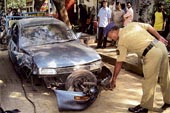
India: Drunk driver mows down homeless, kills 7

MUMBAI India: A drunk driver mowed down a group of homeless construction workers asleep on the sidewalk, killing seven, including a pregnant woman and two children, and injuring eight others Nov. 13. Police found a bottle of liquor in the car. The slaughter was the latest in a series. In the words of the Reuters news agency: "Boisterous sons of India's growing middle class returning drunk from late night parties have been involved in a spate of accidents in recent years." Source. More details.

Saturday, October 28, 2006

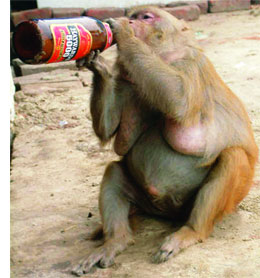
Alcoholic monkey attacks people for beer

Idle taxi drivers in Unnao state in Northern India got this feral monkey drunk a decade ago, and now she's a full-blown alcoholic that attacks people and steals their beer. Source. Although addiction in feral animals seems to be rare, it's common in laboratory animals. More than 50 years ago, a researcher, Spragg, described chimpanzees who "would drag the researcher to the cupboard where the morphine, syringes, and needles were stored, and voluntarily assume the proper position to receive the injections." Source. A wide range of animals, ranging down to fruit flies, has been used in addiction experiments. The well-documented phenomenon of addiction in animals is a challenge to theories that locate the cause of addiction in spiritual maladjustment.

Tuesday, October 10, 2006

Terror Treatment in India

"Yes, we do beat them up when they don't listen to us. What else is there to do?" -- A staff member at the Paras Foundation addiction treatment center in Mohali, India. A Times of India investigative team found 70 "inmates" of the program sleeping on the floor in one room. Addicts are made to squat and stare at the wall for hours for minor infractions. There is no medical staff. Food is slop thrown together in a squalid kitchen. The Times says inmates "were routinely tortured and abused." Source.